d.tech RESOURCES
Isabelle Hau on Relational Intelligence in the Age of AI
The full slides from our Human Agency Salon
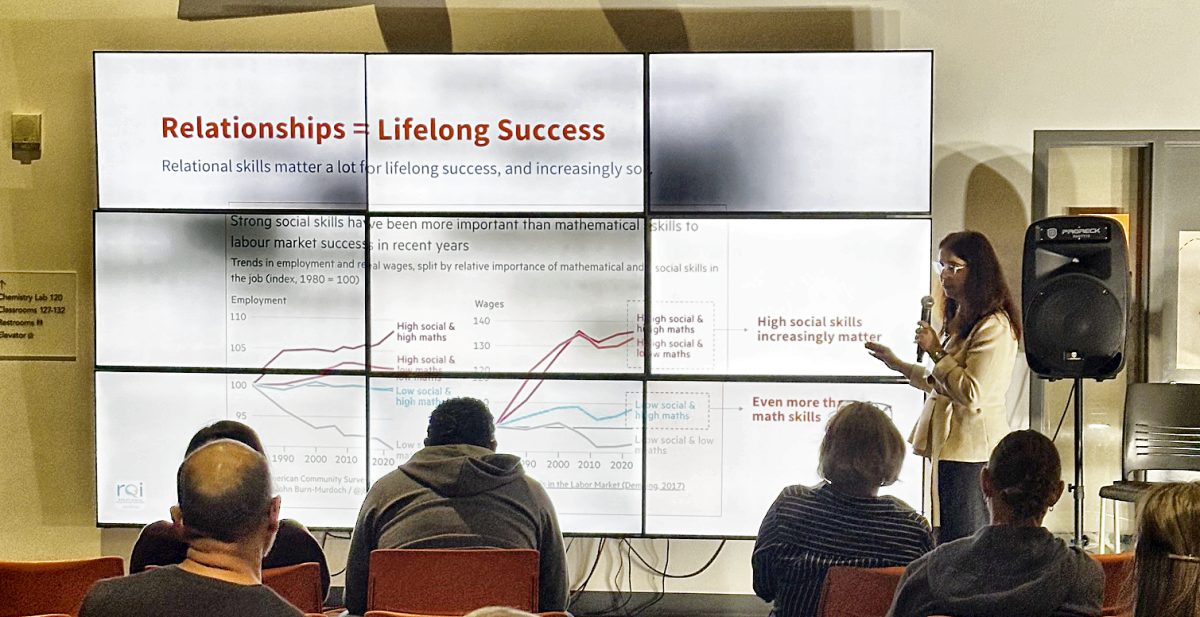
This free download includes Isabelle Hau’s complete presentation from one of our Human Agency Salons at d.tech. It covers the research on why human connection matters more than ever, and what schools and families can do about it.
As AI becomes more capable, the question isn’t only what our students will be able to do. It’s who they’ll become, and who they’ll become it with.
Isabelle is Executive Director of the Stanford Accelerator for Learning and author of Love to Learn. She makes the case that we’re entering a relational economy while living through a relational recession. Jobs that demand strong social skills have outpaced math-heavy jobs in both employment and wages for decades. Yet the share of Americans reporting no close friends has quadrupled since 1990, and teen in-person socializing has fallen sharply.
Her answer is relational intelligence: the capacity to connect, build trust, navigate difference and make meaning together. It’s learnable. It’s measurable. And for schools, it’s foundational.
Download the slides
Inside the slides
-
The science of how relationships shape brain development, learning and wellbeing
-
The data behind the “relational recession,” and how AI is arriving into it
-
A framework for relationship-centered learning, with schools as relational hubs.
Design Tech High School (d.tech) is a public high school in the San Francisco Bay Area built entirely around design thinking. In partnership with Oracle, d.tech has developed innovation programs now used by students and schools around the world. This guide draws directly from the same frameworks we use with our students every day.
FAQs
Who is this guide for?
Any high school student working on their college application essay, and the parents, teachers, and counselors supporting them.
How will this help my student get into college?
A stronger, more specific essay won't guarantee a decision, but it's often the difference between an application that blends in and one that stands out. This guide helps your student find their real story and tell it clearly, which is exactly what admissions readers say they're looking for.
When should students start working on their college essay?
The earlier the better, but the framework works at any stage. Most students find it most useful during their junior year, with enough time to think before the pressure sets in.
Does this work for the Common App essay?
Yes. The framework is built around helping students find and shape their story, which applies to the Common App personal statement and most supplemental essays.
Does my student need to know about design thinking to use this guide?
The framework is built on design thinking principles, but students work through it as a series of questions. No prior experience needed.
Is this really free?
Yes. Enter your name and email and we'll send it straight to your inbox.